


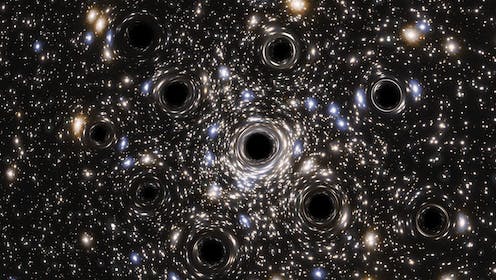

Artist’s rendition of a concentration of small black holes in the centre of the galaxy NGC 6397. ESA/Hubble, N. Bartmann., CC BY-SA
One of the most intriguing predictions of Einstein’s general theory of relativity is the existence of black holes: astronomical objects with gravitational fields so strong that not even light can escape them.
When a sufficiently massive star runs out of fuel, it explodes and the remaining core collapses, leading to the formation of a stellar black hole (ranging from 3 to 100 solar masses).
Supermassive black holes also exist in the centre of most galaxies. These are the largest type of black hole, containing between one hundred thousand and ten billion times more mass than our Sun.
So far, astronomers have captured images of two supermassive black holes: one in the centre of the galaxy M87, and the most recent in our Milky Way (Sagittarius A*).
This animation shows a size comparison between these two giants:
But it’s believed that another kind of black hole exists – the primordial or primitive black hole (PBHs).
These have a different origin to other black holes, having formed in the early universe through the gravitational collapse of extremely dense regions.
Theoretically, these primordial black holes can possess any mass, and may range in size from a subatomic particle to several hundred kilometres. For instance, a PBH with a mass equivalent to Mount Everest could have the size of an atom.
These tiny black holes lose mass at a faster rate than their massive counterparts, emitting so-called Hawking radiation, until they finally evaporate.
Recreation of an isolated primordial black hole. NASA/ESA and G. Bacon (STScI).
Up to now, astronomers have not been able to observe PBHs. This is a subject of ongoing research since it is assumed that these ultra-compact objects might be part of the long-searched-for dark matter of the universe.
An alternative scenario for detecting atom-sized primordial black holes is proposed in a recent publication. In this research, the characteristic signal of the interaction between one of these tiny black holes and one of the densest objects in the universe (a neutron star) is studied.
Before embarking on this new astrophysical model, let us now comment on the main characteristics of these fascinating stars.
One of the densest objects in the universe
As previously mentioned, when a massive star runs out of fuel, it explodes and its core collapses, resulting in a stellar black hole. It ought to be stressed this is not the case in every scenario: for example, if the collapsing core is less massive than about three solar masses, a neutron star is formed.
These are very small and extremely dense objects. For instance, consider a star with 1.5 solar masses compressed into a sphere of only 20 kilometres in diameter (the size of Manhattan island).
The density of a neutron star is extremely high: a tablespoon of star material would weigh millions of tons!
The youngest neutron stars belong to a subclass called pulsars which spin at extremely high velocities (even faster than a kitchen blender). These pulsars emit radiation in the form of narrow beams that periodically reach the Earth.
Over time, these objects cool down and lose their rotational speed, being difficult to detect (only the most energetic pulsars have been observed).
The interaction of an atomic-sized PBH with a neutron star
Primordial black holes might be located in galactic regions where the concentration of dark matter is remarkably high. Thus, they could roam the Universe (moving at different speeds and directions) and eventually interact with other astronomical objects (such as black holes or neutron stars).
In this sense, an atom-sized PBH could encounter an old neutron star (whose temperature is notably low and has lost practically all of its rotational velocity). According to this recent research, the frequency of these encounters would be in the order of 20 events per year. Nevertheless, most of these interactions would be difficult to observe (due to the huge distances and an appropriate orientation from the Earth).
Two possible scenarios are considered: first, when the PBH is captured by the neutron star and second, when the minuscule black hole comes in from long distances, goes around the NS and then moves out to “infinity” again (that is, a scattering event). Depending on the specific orbit (a capture or a scattering) a characteristic and unique signal is generated.
In the following animation, a detailed description of the scattering event is shown:
The abovementioned signal is called a gamma-ray burst (GRB), probably, one of the most energetic events in the Universe.
A particular kind of GRB
These high-energy transient emissions last from milliseconds to several hours and their sources are located billions of light years away from Earth. A great amount of energy is released as very narrow beams.
The shorter GRBs are caused by the merger of neutron stars or black holes, while the longer bursts have their origin in the death of massive stars (the so-called supernovae).
In our particular case, the GRB has a duration of about 35 seconds, with a very specific condition: a smooth and sustained emission, followed by an abrupt and rapid decrease in just a few hundredths of a second.
Atomic-sized PBH detection: an impossible task?
This is not an easy question to answer, given the complexity of searching for such tiny black holes.
Nonetheless, if such a particular GRB is measured by modern telescopes (and matches the specific signature reported in this research), it could be argued that an ancient PBH – neutron star interaction occurred in the early Universe.
In other words, it would provide experimental evidence of such low-mass primordial black holes, one of the fundamental predictions of Stephen Hawking.
It will not be an easy task (maybe, such GRBs might never be found) but we cannot completely rule out such a possibility: only time will tell.
Oscar del Barco Novillo no recibe salario, ni ejerce labores de consultoría, ni posee acciones, ni recibe financiación de ninguna compañía u organización que pueda obtener beneficio de este artículo, y ha declarado carecer de vínculos relevantes más allá del cargo académico citado.



 Seguir
 Seguir
 Seguir
 Seguir
 Subscribe
 Seguir

Luciana Gatti entra en política porque el Congreso brasileño está legislando la catástrofe
Luciana Gatti lleva más de 30 años estudiando la Amazonia y los gases que aceleran el calentamiento global. Es investigadora principal del Instituto Nacional de Investigaciones Espaciales de Brasil, el INPE, y coordina su Laboratorio de Gases de Efecto Invernadero. No es una tertuliana reciclada, una celebridad buscando foco ni una profesional de la política fabricada en un despacho. Es una científica que ha dedicado décadas a medir cómo uno de los mayores reguladores climáticos del planeta está dejando de funcionar.
Ahora ha decidido presentarse al Congreso.
Gatti anunció el 13 de julio su precandidatura a diputada federal por São Paulo dentro del Partido Socialismo y Libertad, el PSOL. Las candidaturas deberán registrarse oficialmente antes del 15 de agosto y la primera vuelta de las elecciones brasileñas se celebrará el 4 de octubre. Su objetivo es llevar la ciencia al lugar donde se aprueban las leyes que están acelerando el desastre. Porque publicar investigaciones sirve de poco cuando quienes legislan las ignoran, las niegan o directamente trabajan para las empresas responsables.

Ecuador abandona la Amazonia al oro ilegal y deja solos a quienes la protegen
La Amazonia ecuatoriana está siendo devorada por la minería ilegal mientras el Estado llega tarde, responde a medias o directamente mira hacia otro lado. Retroexcavadoras, dragas, campamentos clandestinos y grupos armados avanzan sobre territorios indígenas y áreas protegidas. Frente a ellos, 598 guardaparques abandonados a su suerte, sin capacidad legal para incautar maquinaria y sin medios para enfrentarse a organizaciones que llevan fusiles.
En el Parque Nacional Sumaco Napo-Galeras, varios trabajadores fueron interceptados durante una inspección por hombres fuertemente armados que afirmaron proporcionar seguridad a los mineros. Les quitaron los teléfonos, el GPS y la cámara. Quienes debían representar la autoridad ambiental terminaron desarmados, retenidos y obligados a explicar qué hacían dentro del espacio que estaban protegiendo. Los delincuentes pedían cuentas a los guardaparques y no al revés.

Ayuso convierte la cultura madrileña en un photocall pagado con dinero público
La política cultural de Isabel Díaz Ayuso tiene una regla bastante sencilla: para las creadoras y creadores corrientes existen formularios, convocatorias, límites presupuestarios y meses de espera; para las celebridades dispuestas a promocionar Madrid y posar junto al poder aparecen patrocinios millonarios, espacios públicos y contratos diseñados específicamente para ellas.
No es mecenazgo. Tampoco es una defensa desinteresada de la cultura. Es dinero público utilizado para comprar prestigio, propaganda turística y fotografías institucionales. La obra artística queda reducida a soporte publicitario y las administraciones se comportan como una agencia de representación financiada por las y los contribuyentes.
Nacho Cano fue durante años el mejor ejemplo de este modelo. Ahora Woody Allen recoge el testigo con un proyecto que recibirá 3 millones de euros de la Comunidad y del Ayuntamiento de Madrid. Dos nombres famosos, dos operaciones presentadas como apoyo cultural y una misma lógica: socializar el coste para que el beneficio político y empresarial quede en pocas manos.

THUNDERFORGE – El PENTÁGONO se echa en manos de la INTELIGENCIA ARTÍFICIAL #ReportajeS
El Pentágono ha dado un paso sin precedentes: poner la toma de decisiones y la estrategia militar en manos de la inteligencia artificial. Patricia Salvador te cuenta en este #ReportajeSR cómo, a…

STARSHIELD: la GUERRA PRIVADA (con dinero público) de MUSK #ReportajeSR
¿Es Elon Musk más poderoso que un Estado? Analizamos cómo SpaceX ha dejado de ser una empresa de cohetes para convertirse en el «sistema nervioso» de la guerra moderna. Desde el uso…
MODO REVOLUCIÓN
Activa el Modo Revolución con nosotras. Historias, investigaciones, vídeos y claves para entender qué está pasando y qué hay detrás.
También te puede interesar
Un toro de 300 metros: obscenidad franquista en versión parque temático
28 julio 2025PSOE: manual de cierre de filas en cinco pasos (y por qué siempre falla)
13 junio 2025Mazón no quiere dimitir: utiliza una remodelación para eludir responsabilidades
14 noviembre 2024La caída de un imperio: Elon Musk y todos sus frentes abiertos anuncian el final de un magnate
19 agosto 2024