


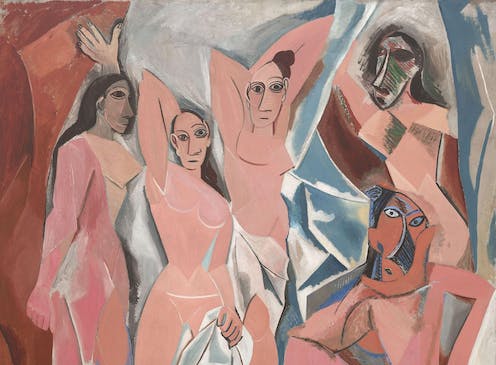

‘Les Demoiselles d’Avignon’, by Pablo Picasso, 1907. MoMA / Wikimedia Commons
At the end of the 19th century, long before starting to speak, Pablo Ruiz Picasso (1881-1973) was already drawing – and he grew up “capturing” everything he saw with a pencil.
Through several of the drawings and sketches in pencil made by the young man from Malaga during his formative years in A Coruña (1891-1895), in the North of Spain, we can see clear foreshadowing of what became a revolution that spanned the arts, the limits of perception, communication and expression. The young Picasso’s work was an early form of cubism, an artistic and stylistic movement that officially began in 1907 with the famous painting Les Demoiselles d’Avignon (The Young Ladies of Avignon – in reference to an old and well-known street in Barcelona with brothels), painted by Picasso.
The fourth dimension (and beyond)
Picasso made cubism official in 1907, but it was something that he had already been able to imagine and begin to represent in some drawings from his time and apprenticeship in A Coruña: the ability to create a new style, a new artistic way of seeing and representing reality.
This made it possible to go beyond the creative limit set by the painters of the Italian Renaissance. They had managed to represent the perfectly consolidated third dimension in a scientific way in Italian Quattrocento paintings – with the first dimension being height, the second width, and the third depth (thanks to the geometric rules of perspective).
In Christ Giving the Keys to St. Peter, by Perugino (1481-1482), it is perfectly clear how the third dimension is achieved through perspective (the piece’s correct depth).
Wikimedia Commons
Picasso went further and achieved the representation of another three dimensions. He depicted a fourth dimenson – the ability to represent the back – or what is not perceived but what we know is there, for example, the face and the nape of a single character in the same plane.
The fifth dimension (or “depth” dimension) is, for example, the representation of a bare chest with a heart, normally invisible under the epidermis, or the lung. This, in the Renaissance, would have been unthinkable – what was not seen was not represented.
The sixth dimension is the imagined or “dreamlike” dimension. This is what is not there or cannot be seen but what we know exists in the imagination or we have seen in a dream (thus, Picasso was also several years ahead of surrealism).
Cubism before a mirror
A good example of these dimensions is the painting Girl before a Mirror, from 1932, which is in the Museum of Modern Art in New York.
Girl before a Mirror, by Pablo Picasso, held by the Museum of Modern Art in New York.
Neil R / Flickr, CC BY-NC
In this portrait of his muse and lover, Marie-Thérèse Walter, we can see the fourth dimension thanks to the face in profile view and the same face in frontal-view. The horizontal black stripes on the left are Marie-Thérèse’s ribs and, therefore, they make reference to the fifth dimension, also present in the representation of a foreshadowed pregnancy in a circumference.
The imagined (or dreamt) vision of Picasso – the sixth dimension – is portrayed in the way in which the mirror reflects an image back at the model of an ugly and decrepit woman who gazes at death. Picasso thus creates an exciting cubist piece with brilliant polychromy.
All this exists and, according to Picasso, can be represented on a single canvas, board or two-dimensional paper.
From the beginning
Picasso was always talented and even unique. He never drew pictures like a child does – “not even when he was very young,” according to his own account. His viewpoint was always adult in nature.
That is why it is so important to revisit Picasso’s drawings from his time in A Coruña (1891-1895). At first glance, they seem just children’s drawings like any others… but they are a lot more than that.
It is necessary to examine them very carefully to truly notice how the birth of a genius came about and how the revolution that was cubism was born. How, from this point on, reality would be represented not always in a hyper-realistic way, as had more or less happened until then, but segmented into geometric, cubic, abstract planes. An incredible turn.
Indicative details
Doble estudio de perfil de un hombre barbudo (Double Profile Study of a Bearded Man), 1892-1893, private collection.
Author provided
For example, in Double Profile Study of a Bearded Man, the geometric framing of the face is an analytical dissection that surpasses conventional academic work. At first glance, this is an ordinary exercise in the geometric composition of a male face, but the forcefulness of the lines used to mark proportions and the resolute manner of the dark spots (eyebrow, nose, and mouth) foreshadow elements that Picasso will explore further in later cubism.
Personaje con pipa (Person with a Pipe), 1894-1895, A Coruña.
Picasso Museum, Barcelona
In Personaje con pipa (Person with a Pipe), the young Picasso incorporates the subtle white chalk technique to artistically accentuate the clothing of the character, as the crossing stripes on the lapel show. Pablo Ruiz was beginning to guide and lead his conceptual way of working towards the adult Picasso.
The geometric compositional structure in Caserío gallego (Galician Homestead), elaborated with simple abstraction of space, is related with the rationalist exploration of forms that Picasso would undertake in the 20th century.
In Houses on the Hill of Horta de Ebro, it becomes evident that the geometric and shadow play of this piece had already been foreshadowed in the previous homestead piece.
On the left, Caserío gallego (Galician Homestead), painted in A Coruña. On the right, Houses on the Hill of Horta de Ebro, 1909.
Picasso Museum, Barcelona/MOMA
Obviously, it cannot be said that there are glimpses of forms that point towards the Cubist revolution in all the drawings from A Coruña.
But, if the previous pieces and some others are observed, we will see that something of what was to come was beginning to take shape in the Galician city.
Ximo Company i Climent does not work for, consult, own shares in or receive funding from any company or organization that would benefit from this article, and has disclosed no relevant affiliations beyond their academic appointment.


 Seguir
 Seguir
 Seguir
 Seguir
 Subscribe
 Seguir

Luciana Gatti entra en política porque el Congreso brasileño está legislando la catástrofe
Luciana Gatti lleva más de 30 años estudiando la Amazonia y los gases que aceleran el calentamiento global. Es investigadora principal del Instituto Nacional de Investigaciones Espaciales de Brasil, el INPE, y coordina su Laboratorio de Gases de Efecto Invernadero. No es una tertuliana reciclada, una celebridad buscando foco ni una profesional de la política fabricada en un despacho. Es una científica que ha dedicado décadas a medir cómo uno de los mayores reguladores climáticos del planeta está dejando de funcionar.
Ahora ha decidido presentarse al Congreso.
Gatti anunció el 13 de julio su precandidatura a diputada federal por São Paulo dentro del Partido Socialismo y Libertad, el PSOL. Las candidaturas deberán registrarse oficialmente antes del 15 de agosto y la primera vuelta de las elecciones brasileñas se celebrará el 4 de octubre. Su objetivo es llevar la ciencia al lugar donde se aprueban las leyes que están acelerando el desastre. Porque publicar investigaciones sirve de poco cuando quienes legislan las ignoran, las niegan o directamente trabajan para las empresas responsables.
Ecuador abandona la Amazonia al oro ilegal y deja solos a quienes la protegen
La Amazonia ecuatoriana está siendo devorada por la minería ilegal mientras el Estado llega tarde, responde a medias o directamente mira hacia otro lado. Retroexcavadoras, dragas, campamentos clandestinos y grupos armados avanzan sobre territorios indígenas y áreas protegidas. Frente a ellos, 598 guardaparques abandonados a su suerte, sin capacidad legal para incautar maquinaria y sin medios para enfrentarse a organizaciones que llevan fusiles.
En el Parque Nacional Sumaco Napo-Galeras, varios trabajadores fueron interceptados durante una inspección por hombres fuertemente armados que afirmaron proporcionar seguridad a los mineros. Les quitaron los teléfonos, el GPS y la cámara. Quienes debían representar la autoridad ambiental terminaron desarmados, retenidos y obligados a explicar qué hacían dentro del espacio que estaban protegiendo. Los delincuentes pedían cuentas a los guardaparques y no al revés.

Ayuso convierte la cultura madrileña en un photocall pagado con dinero público
La política cultural de Isabel Díaz Ayuso tiene una regla bastante sencilla: para las creadoras y creadores corrientes existen formularios, convocatorias, límites presupuestarios y meses de espera; para las celebridades dispuestas a promocionar Madrid y posar junto al poder aparecen patrocinios millonarios, espacios públicos y contratos diseñados específicamente para ellas.
No es mecenazgo. Tampoco es una defensa desinteresada de la cultura. Es dinero público utilizado para comprar prestigio, propaganda turística y fotografías institucionales. La obra artística queda reducida a soporte publicitario y las administraciones se comportan como una agencia de representación financiada por las y los contribuyentes.
Nacho Cano fue durante años el mejor ejemplo de este modelo. Ahora Woody Allen recoge el testigo con un proyecto que recibirá 3 millones de euros de la Comunidad y del Ayuntamiento de Madrid. Dos nombres famosos, dos operaciones presentadas como apoyo cultural y una misma lógica: socializar el coste para que el beneficio político y empresarial quede en pocas manos.

THUNDERFORGE – El PENTÁGONO se echa en manos de la INTELIGENCIA ARTÍFICIAL #ReportajeS
El Pentágono ha dado un paso sin precedentes: poner la toma de decisiones y la estrategia militar en manos de la inteligencia artificial. Patricia Salvador te cuenta en este #ReportajeSR cómo, a…
STARSHIELD: la GUERRA PRIVADA (con dinero público) de MUSK #ReportajeSR
¿Es Elon Musk más poderoso que un Estado? Analizamos cómo SpaceX ha dejado de ser una empresa de cohetes para convertirse en el «sistema nervioso» de la guerra moderna. Desde el uso…
MODO REVOLUCIÓN
Activa el Modo Revolución con nosotras. Historias, investigaciones, vídeos y claves para entender qué está pasando y qué hay detrás.
También te puede interesar
Un toro de 300 metros: obscenidad franquista en versión parque temático
28 julio 2025PSOE: manual de cierre de filas en cinco pasos (y por qué siempre falla)
13 junio 2025Mazón no quiere dimitir: utiliza una remodelación para eludir responsabilidades
14 noviembre 2024La caída de un imperio: Elon Musk y todos sus frentes abiertos anuncian el final de un magnate
19 agosto 2024