


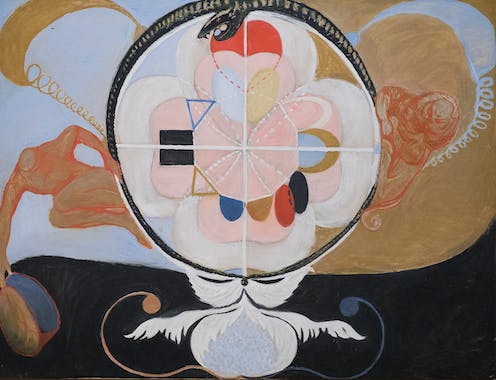

‘Evolution, No. 13, Group VI’, 1908. Hilma af Klint. Rhododendrites / Wikimedia Commons, CC BY-SA
Can an exhibition of work by a little-known Swedish artist change our understanding of avant-garde art? The history of early 20th-century art seems to be sufficiently set that the spectral appearance of an artist on the periphery of Europe wouldn’t change it in any way. However, the phenomenon of Hilma af Klint has opened up completely new avenues of study in our approach to abstraction.
Portrait of Hilma af Klint in her studio at Hamngatan in Stockholm. Circa 1885.
Wikimedia Commons
Born in 1862, Hilma af Klint studied at the Royal Academy of Fine Arts in Stockholm, where she developed a naturalistic style in keeping with her academic education. However, in the shadow of this official painting and, in private, she produced a completely different type of work.
Together with four friends she formed the group De Fem (The Five), which held séances from which they derived sketches and instructions. Using these, Af Klint embarked on composing an abstract, symbolic and complex work that sought to represent the order of the cosmos.
This monumental work that Af Klint began in 1908 is now considered the first manifestation of abstraction.
Seeking inclusion in the canon
Although Af Klint’s work had been shown in a number of collective exhibitions before, in 2013 the Moderna Museet in Stockholm devoted a monographic exhibition to her
, which revealed the breadth and brilliance of her oeuvre.
This had been hidden for 40 years at the artist’s wish, as she hoped that future society would be prepared to better understand her ideas. This seems to have been the case, as the exhibition was a success with both the public and the critics. After its presentation at home, Hilma af Klint began a tour of the world’s most renowned museums and travelled as far as the Antipodes.
The name of the original exhibition, “Hilma af Klint. Pioneer of abstraction”, made things clear: the Moderna Museet wanted to claim that the first abstract painter was Swedish. It was an attempt to introduce a new figure into the select canonical group of the great masters of the avant-garde, a woman in an eminently male list. The intention was not to change the narrative of contemporary art, but to complete it with a national figure.
That is why in the Stockholm exhibition De Fem only appeared at the end, in a tangential way, so as not to detract from the real and only protagonist. But the exhibition not only launched a new vein of merchandising, but also opened a hitherto veiled window. And out of it emerged the spiritualists.
The emergence of spiritualists
It was not the interest in the supernatural that came as a surprise: the relationship of many abstract artists to the doctrine of theosophy was well known, and some of its fruits, such as Kandinsky’s Concerning the Spiritual in Art, were widely disseminated. The surprise was that, following in the wake of Af Klint, studies began to emerge of women who, guided by their conversations with spirits, had experimented with abstraction as early as 1861, as in the case of Georgiana Houghton.
Suddenly, new artist mediums were appearing everywhere, and along with them a whole field of research that had previously been neglected. What began in Stockholm as an attempt to include a new actress in a well-structured story —- that of the masculine and rational avant-garde where a touch of spiritualism coloured the narrative – became an inescapable change of gear. Hilma af Klint was not a pioneer, but a leading member of a social and artistic impulse that went beyond her and had left a strong mark on the more experimental avant-garde.
New avenues for a richer and more complex history
The appearance of new authors has in turn encouraged the study of the relationship of other avant-garde artists with spiritual doctrines, and has made it clear that the occult, the esoteric and the spiritual had a fundamental place in the avant-garde.
‘Altarpiece, No. 1, Group X, Altarpieces, de Hilma af Klint. 1907. Photo by Albin Dahlström/ Moderna Museet.
Wikimedia Commons
It is also becoming clear that the protagonists of these trends were mainly women. As the artist Olivia Plender said, it is not surprising that the mediums were female, since speaking with the voice of another could be the only way to be heard. Nor is it surprising that these artists, writers and influencers of their time have been left in the shadows of a profoundly heteropatriarchal art history.
Now, the window that Hilma af Klint opened for us is widening, and another field of study is asking for its place in the foundations of the avant-garde: dance, closely related to esotericism and oriental cultures.
In 1944, Af Klint wrote in his will that his works would not be shown until 40 years after her death, when the world would be more ready to understand them. She was optimistic. It has taken almost twice as long, but it seems we are finally getting there.
Haizea Barcenilla does not work for, consult, own shares in or receive funding from any company or organization that would benefit from this article, and has disclosed no relevant affiliations beyond their academic appointment.


 Seguir
 Seguir
 Seguir
 Seguir
 Subscribe
 Seguir

Luciana Gatti entra en política porque el Congreso brasileño está legislando la catástrofe
Luciana Gatti lleva más de 30 años estudiando la Amazonia y los gases que aceleran el calentamiento global. Es investigadora principal del Instituto Nacional de Investigaciones Espaciales de Brasil, el INPE, y coordina su Laboratorio de Gases de Efecto Invernadero. No es una tertuliana reciclada, una celebridad buscando foco ni una profesional de la política fabricada en un despacho. Es una científica que ha dedicado décadas a medir cómo uno de los mayores reguladores climáticos del planeta está dejando de funcionar.
Ahora ha decidido presentarse al Congreso.
Gatti anunció el 13 de julio su precandidatura a diputada federal por São Paulo dentro del Partido Socialismo y Libertad, el PSOL. Las candidaturas deberán registrarse oficialmente antes del 15 de agosto y la primera vuelta de las elecciones brasileñas se celebrará el 4 de octubre. Su objetivo es llevar la ciencia al lugar donde se aprueban las leyes que están acelerando el desastre. Porque publicar investigaciones sirve de poco cuando quienes legislan las ignoran, las niegan o directamente trabajan para las empresas responsables.

Ecuador abandona la Amazonia al oro ilegal y deja solos a quienes la protegen
La Amazonia ecuatoriana está siendo devorada por la minería ilegal mientras el Estado llega tarde, responde a medias o directamente mira hacia otro lado. Retroexcavadoras, dragas, campamentos clandestinos y grupos armados avanzan sobre territorios indígenas y áreas protegidas. Frente a ellos, 598 guardaparques abandonados a su suerte, sin capacidad legal para incautar maquinaria y sin medios para enfrentarse a organizaciones que llevan fusiles.
En el Parque Nacional Sumaco Napo-Galeras, varios trabajadores fueron interceptados durante una inspección por hombres fuertemente armados que afirmaron proporcionar seguridad a los mineros. Les quitaron los teléfonos, el GPS y la cámara. Quienes debían representar la autoridad ambiental terminaron desarmados, retenidos y obligados a explicar qué hacían dentro del espacio que estaban protegiendo. Los delincuentes pedían cuentas a los guardaparques y no al revés.

Ayuso convierte la cultura madrileña en un photocall pagado con dinero público
La política cultural de Isabel Díaz Ayuso tiene una regla bastante sencilla: para las creadoras y creadores corrientes existen formularios, convocatorias, límites presupuestarios y meses de espera; para las celebridades dispuestas a promocionar Madrid y posar junto al poder aparecen patrocinios millonarios, espacios públicos y contratos diseñados específicamente para ellas.
No es mecenazgo. Tampoco es una defensa desinteresada de la cultura. Es dinero público utilizado para comprar prestigio, propaganda turística y fotografías institucionales. La obra artística queda reducida a soporte publicitario y las administraciones se comportan como una agencia de representación financiada por las y los contribuyentes.
Nacho Cano fue durante años el mejor ejemplo de este modelo. Ahora Woody Allen recoge el testigo con un proyecto que recibirá 3 millones de euros de la Comunidad y del Ayuntamiento de Madrid. Dos nombres famosos, dos operaciones presentadas como apoyo cultural y una misma lógica: socializar el coste para que el beneficio político y empresarial quede en pocas manos.

THUNDERFORGE – El PENTÁGONO se echa en manos de la INTELIGENCIA ARTÍFICIAL #ReportajeS
El Pentágono ha dado un paso sin precedentes: poner la toma de decisiones y la estrategia militar en manos de la inteligencia artificial. Patricia Salvador te cuenta en este #ReportajeSR cómo, a…

STARSHIELD: la GUERRA PRIVADA (con dinero público) de MUSK #ReportajeSR
¿Es Elon Musk más poderoso que un Estado? Analizamos cómo SpaceX ha dejado de ser una empresa de cohetes para convertirse en el «sistema nervioso» de la guerra moderna. Desde el uso…
MODO REVOLUCIÓN
Activa el Modo Revolución con nosotras. Historias, investigaciones, vídeos y claves para entender qué está pasando y qué hay detrás.
También te puede interesar
Un toro de 300 metros: obscenidad franquista en versión parque temático
28 julio 2025PSOE: manual de cierre de filas en cinco pasos (y por qué siempre falla)
13 junio 2025Mazón no quiere dimitir: utiliza una remodelación para eludir responsabilidades
14 noviembre 2024La caída de un imperio: Elon Musk y todos sus frentes abiertos anuncian el final de un magnate
19 agosto 2024