



Este medio se sostiene gracias a su comunidad. APOYA EL PERIODISMO INDEPENDIENTE .
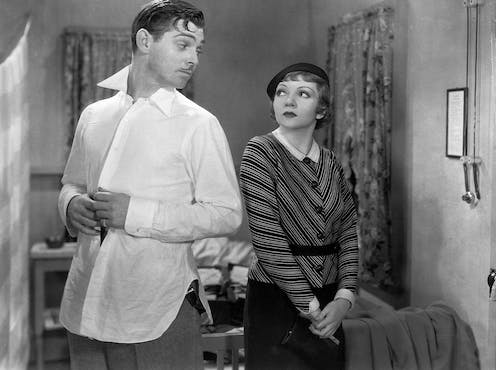
Still from Frank Capra’s ‘It Happened One Night’ (1934). FilmAffinity
“Death to romantic love”, declared a celebration of a feminist Valentine’s Day promoted by a group of students on posters visible in Zaragoza (Spain) in the days leading up to 14 February 2020.
The feminist slogan reminded me of a little-known passage from Shakespeare, when at the beginning of Henry IV, Part 1, Hotspur, an exalted warrior, is about to depart for his next battle. His wife tries to convince him to stay with her. Spurring his horse, he replies: “This is no world / To play with mammets and to tilt with lips. / We must have bloody noses and cracked crowns.”
May the rom-com die
We could use “tilting with lips” as a definition of romantic comedy; the genre most damned in Hollywood for being conservative, repetitive and predictable.
For most film critics and scholars, and for a large part of the audience, comedy means frivolity. Romantic comedy means little artistic quality or originality. In the title of her Washington Post article, in which she joins the chorus of those predicting the death of the genre, journalist Emily Yahr was blunt: “The rom-com is dead. Good.”
For Yahr, as for others, the idea of a genre in which a usually white, often affluent, boy and girl meet, fall in love, get married and live happily ever after involves racism, classism, heterosexuality, monogamy, cisgender bias, a happy ending and marriage.
So deep is the belief in the inflexible boy-meets-girl structure that only those films that fit the bill are considered romantic comedies. If a film varies the formula, or if it is directed by an “auteur” of more or less prestige, it is no longer a romantic comedy. For example, Ernst Lubitsch’s great (romantic) comedies, such as Trouble in Paradise (1932), The Shop Around the Corner (1939) and To Be or Not to Be (1942) have been considered anything but romantic comedies.
Still from the film The Shop Around the Corner, by Ernst Lubitsch.
FilmAffinity
Shakespeare and the origin of romantic comedies
But let’s go back to Shakespeare, the playwright who, while not inventing anything, channelled the tradition of 16th century Italian narratives and dramas, themselves indebted to the comedies of Plautus and Terence and inspired by the stories of Ovid’s Metamorphoses, the Petrarchan tradition of unrequited love and courtly love, the comic and erotic tales of Bocaccio’s Decameron and medieval romances, together with Eastern influences.
From this cocktail, Shakespeare consolidated and popularised the genre which, after several centuries of evolution, would lead to its current form. Admittedly, most of his comedies end with a celebration in the form of a wedding, almost always a double or multiple one.
However, what is interesting is the middle section of the plot, where we find a desire so intense that it changes our lives forever. “Even so quickly may one catch the plague,” wonders Olivia in Twelfth Night as she realises the passion she suddenly feels for Cesario, a young man who is actually a woman. In Shakespeare, desire is instantaneous, violent, brutal, impossible to tame. Therein lies the fascination of the genre.
Verbal battles and erotic games
In romantic comedy, this irrepressible impulse is mediated by humour, laughter and comic flair. This humour encapsulates, on one hand, the joy and delight of the lovers and, on the other, mocks the ridiculousness of those who are obsessed by passion and, above all, those who despise desire and fake it for social preferment or power, such as the sexual predators of The Apartment (1960).
Erotic play is verbalised as dialogues between lovers that seem to convey enmity and antagonism but which we all understand as a sign of emotional and sexual compatibility.
Such verbal battles, from Shakespeare to the present day, are a recurring convention of the genre. Just look at films like It Happened One Night (1934), The Awful Truth (1937), His Girl Friday (1940), Man’s Favorite Sport? (1964), Groundhog Day (1993) or The Curse of the Jade Scorpion (2001).
And despite what decades of film might have implied, the conventions of the genre need not be limited to just one race, social class, gender or sexual orientation.
A scene from His Girl Friday, with Cary Grant and Rosalind Russell. This film is full of fast and fierce dialogue that reflects the attraction and romantic compatibility between the protagonists.
Wikimedia Commons
Romantic comedy is not dying, it’s just changing
When, in the mid-2010s, proclamations of the death of the genre reappeared, what was actually happening, as Beatriz Oria and Maria San Filippo have shown, was its umpteenth mutation and displacement towards other spaces: independent cinema, digital platforms or web series, breaking sacred moulds, at least for critics, increasing the visibility of homosexual relationships, interracial and transnational love, love and sexuality in adolescence and maturity, polyamory and difference, all through the lens of comedy.
This can be seen in Gambit (2011), About Last Night (2013), Amira & Sam (2014), Sleeping with Other People (2015), Crazy Rich Asians (2018) and The Half Of It (2020), among many others.
Still from Sean Mullin’s 2014 film Amira & Sam.
IMDB
In an extremely volatile and rapidly changing world, threats to the primacy of desire, the first commandment of romantic comedy, are proliferating. The most obvious of these threats is rampant neoliberalism and the exacerbation of what Oria lucidly summarises as “me, myself, and I” and Mary Harrod, Suzanne Leonard and Diane Negra describe as “romantic despair in the age of the self.”
As Maria San Filippo assures, the proliferation of acceptable forms of desire in the contemporary audiovisual landscape is staggering, as is people’s ability to maintain a sense of humour in the most adverse circumstances.
The death of romantic love as feminist symbol
Given the history of marriage as a social institution in patriarchy, it may be understandable that certain feminist discourses wish for the death of romantic love as a step towards equality.
But it is also worth remembering, for example, that the erotic and comic stories of the Decameron are women’s stories. Or that, since Shakespeare, romantic comedy has been one of the few film genres in which the protagonist are a man and a woman on relatively equal terms. Moreover, in most cases, the films give priority to the vicissitudes of women’s desires over those of men.
In general, comedy is still considered the poor sister of tragedy and its successors, the dramatic genres. However, in the century of Pericles, comedy and tragedy were inseparable, the tragic and the comic masks complementary, equally human and equally profound.
Is romantic love dying? Perhaps, but in a fast-paced world that few can comprehend, lips that tilt with other lips – normative or diverse, thin or fleshy, painted or chapped – are no laughing matter.
Celestino Deleyto Alcalá receives funding from the Spanish Ministry of Economy and Competitiveness and the Diputación General de Aragón.
Este periodismo no lo financian bancos ni partidos
Lo sostienen personas como tú. En un contexto de ruido, propaganda y desinformación, hacer periodismo crítico, independiente y sin miedo tiene un coste.
Si este artículo te ha servido, te ha informado o te ha hecho pensar, puedes ayudarnos a seguir publicando.
Cada aportación cuenta. Sin intermediarios. Sin líneas rojas impuestas. Solo periodismo sostenido por su comunidad.
 Seguir
 Seguir
 Seguir
 Seguir
 Subscribe
 Seguir

Luciana Gatti entra en política porque el Congreso brasileño está legislando la catástrofe
Luciana Gatti lleva más de 30 años estudiando la Amazonia y los gases que aceleran el calentamiento global. Es investigadora principal del Instituto Nacional de Investigaciones Espaciales de Brasil, el INPE, y coordina su Laboratorio de Gases de Efecto Invernadero. No es una tertuliana reciclada, una celebridad buscando foco ni una profesional de la política fabricada en un despacho. Es una científica que ha dedicado décadas a medir cómo uno de los mayores reguladores climáticos del planeta está dejando de funcionar.
Ahora ha decidido presentarse al Congreso.
Gatti anunció el 13 de julio su precandidatura a diputada federal por São Paulo dentro del Partido Socialismo y Libertad, el PSOL. Las candidaturas deberán registrarse oficialmente antes del 15 de agosto y la primera vuelta de las elecciones brasileñas se celebrará el 4 de octubre. Su objetivo es llevar la ciencia al lugar donde se aprueban las leyes que están acelerando el desastre. Porque publicar investigaciones sirve de poco cuando quienes legislan las ignoran, las niegan o directamente trabajan para las empresas responsables.

Ecuador abandona la Amazonia al oro ilegal y deja solos a quienes la protegen
La Amazonia ecuatoriana está siendo devorada por la minería ilegal mientras el Estado llega tarde, responde a medias o directamente mira hacia otro lado. Retroexcavadoras, dragas, campamentos clandestinos y grupos armados avanzan sobre territorios indígenas y áreas protegidas. Frente a ellos, 598 guardaparques abandonados a su suerte, sin capacidad legal para incautar maquinaria y sin medios para enfrentarse a organizaciones que llevan fusiles.
En el Parque Nacional Sumaco Napo-Galeras, varios trabajadores fueron interceptados durante una inspección por hombres fuertemente armados que afirmaron proporcionar seguridad a los mineros. Les quitaron los teléfonos, el GPS y la cámara. Quienes debían representar la autoridad ambiental terminaron desarmados, retenidos y obligados a explicar qué hacían dentro del espacio que estaban protegiendo. Los delincuentes pedían cuentas a los guardaparques y no al revés.

Ayuso convierte la cultura madrileña en un photocall pagado con dinero público
La política cultural de Isabel Díaz Ayuso tiene una regla bastante sencilla: para las creadoras y creadores corrientes existen formularios, convocatorias, límites presupuestarios y meses de espera; para las celebridades dispuestas a promocionar Madrid y posar junto al poder aparecen patrocinios millonarios, espacios públicos y contratos diseñados específicamente para ellas.
No es mecenazgo. Tampoco es una defensa desinteresada de la cultura. Es dinero público utilizado para comprar prestigio, propaganda turística y fotografías institucionales. La obra artística queda reducida a soporte publicitario y las administraciones se comportan como una agencia de representación financiada por las y los contribuyentes.
Nacho Cano fue durante años el mejor ejemplo de este modelo. Ahora Woody Allen recoge el testigo con un proyecto que recibirá 3 millones de euros de la Comunidad y del Ayuntamiento de Madrid. Dos nombres famosos, dos operaciones presentadas como apoyo cultural y una misma lógica: socializar el coste para que el beneficio político y empresarial quede en pocas manos.

15.000 personas ya han visto cómo la fe se convierte en poder
El último ReportajeSR analiza cómo determinados sectores del evangelismo conservador dejaron de limitarse a los templos para convertirse en una maquinaria política al servicio de la extrema derecha. De Trump a Bolsonaro, de Milei a Vox: redes comunitarias, guerras culturales, dinero, medios y religión convertidos en infraestructura electoral.
Presentado por Léa Gugelmann, el reportaje ya ha superado las 15.000 visualizaciones desde su estreno. Porque para entender el auge de la extrema derecha no basta con mirar a sus candidatos: también hay que observar quién construye sus discursos, moviliza sus bases y presenta el autoritarismo como una misión divina.

Vídeo | Sadismo en primera persona
Un turista graba el encierro de San Fermín como si estuviera en una atracción. Adrenalina, golpes, risas y animales convertidos en decorado para conseguir un vídeo viral. No está viviendo una tradición: está consumiendo sufrimiento como entretenimiento.
Además, corre con una cámara cuando está prohibido hacerlo, poniendo en peligro a quienes tiene alrededor. La turistificación añade otra capa de irresponsabilidad a una barbaridad ya normalizada: venir, beber, molestar, jugar con la vida ajena y marcharse con unos cuantos clics. El sadismo también se graba en primera persona.