



Este medio se sostiene gracias a su comunidad. APOYA EL PERIODISMO INDEPENDIENTE .
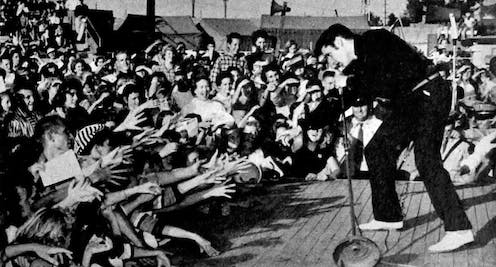
Elvis performing live at the Mississippi-Alabama Fairgrounds in Tupelo, Mississippi, 26 September 1956. Wikimedia Commons
Have you ever wondered what goes through the mind of an author, artist or composer when they create a certain work? Well, you’re not the only one.
In the world of psychology, psychobiography is becoming increasingly valuable. It could be defined as the efficient use of psychological theory to turn a subject’s life into a coherent and enlightening story. This research method has traditionally set its sights on politicians, leaders of social movements and artists.
With regards to artists, psychobiographers discover and analyse the evolution of their personality over time and the relationship between this and their work. They even consider how an artist potentially expresses their internal conflicts through art.
Arthur Miller, Marilyn Monroe and The Crucible
Renowned psychobiographer James W. Anderson, who studied artists and psychologists throughout his career, published several works on Arthur Miller (1915-2005).
In his article The Psychology of Artistic Creativity: With Reference to Arthur Miller and The Crucible, he shared that the playwright was well aware of the personal burden he had placed in his work.
Arthur Miller in a photograph taken in 1966.
Eric Koch / Dutch National Archives
His famous work, The Crucible, tells a story that takes place during the 17th-century trials of women accused of witchcraft in Salem, Massachusetts. Miller used the plot of the story to convey his own fears and experiences during McCarthyism. This persecution, led by Senator Joseph McCarthy in the 1950s in the United States, saw people accused of being communists tried, arrested and publicly rejected.
In addition to the context of the narrative, Miller stated that the essence of the play was the guilt that John Proctor, the protagonist of The Crucible, felt in his private life. When the play begins, Proctor has had an affair with Abigail, his young maid. It is Abigail, obsessed with Proctor, who accuses his wife of being a witch. So his infidelity is the reason for his wife’s trial. While there were no accusations of comunism in Miller’s life, there were nonetheless parallels between the sentimental themes of the story’s protagonist and Miller’s situation.
By that time, Miller, who was married, had already met Marilyn Monroe and was fascinated by the actress. These feelings made him feel like a real traitor to his wife, and although he tried to forget Monroe, he eventually ended up divorcing his wife and marrying her.
Kafka was also a son
Upon reading Kafka’s novella The Judgement, it is logical to think that there must be some kind of similar conflict in the writer’s real life. That’s what prolific psychobiographer Todd Schultz sustains in his article Behind the masks. In the story, a father harshly sentences his son to death by drowning, a wish that the son fulfils by throwing himself into the river.
In his Letter to his Father, published a few years later, Kafka reproaches him precisely for the emotional abuse he suffered, among other things. The author compares himself to vermin, making it clear how his father made him feel.
This, in turn, connects with his great work The Metamorphosis, in which the protagonist suddenly transforms into an insect, leaving him unable to communicate with his surroundings.
Elvis’s loneliness
Elvis Presley mainly performed the musical compositions of others. Although he did not write the songs he recorded, he sometimes adapted the existing ones to suit his own purposes and modified words, phrases and entire lines of some lyrics.
In their chapter entitled “Twelve Ways to Say «Lonesome”: Assessing Error and Control in the Music of Elvis Presley“ in the Handbook of Psychobiography, Alan Elms and Bruce Heller analyse the interpretation of the song ”Are You Lonesome Tonight?“.
Elvis often «ruined” this song during performances, whether he meant to or not. He usually did so by making mistakes in the lyrics or by laughing while singing it. In his last live version, he was on the verge of completely losing it and got to the end of the song with great difficulty.
Elvis performs ‘Are You Lonesome Tonight?’ in the ‘68 Comeback Special, the fifth performance analyzed by Elms and Heller in their studio.
Upon analysing the different live performances of “Are You Lonesome Tonight?”, Elms and Heller discovered that Elvis made many mistakes performing parts of the song where the lyrics expressed loss of control and vulnerability. When the message implied control and power, however, mistakes were significantly fewer.
In other words, the mistakes Elvis made seemed to have a psychological explanation behind them: Elvis was protecting himself. The singer was very afraid of loneliness throughout his life, and this made it difficult for him to sing the song.
Beethoven and death
In my psychobiographical research on the figure of Ludwig van Beethoven (1770-1827), it was very difficult to find an obvious transfer of his story to his work.
Beethoven suffered multiple illnesses, some more serious than others. Although he treated all of these with a stoic attitude, on one occasion he did believe that he was dying. He felt that he still had too much to offer the world and that he could not leave.
When he managed to recover, inspired by this experience, he composed one of the most beautiful movements of his entire collection of works: the third movement of his String Quartet No. 15 in A minor, which he called Heiliger Dankgesang eines Genesenen an der Gottheit, in der Lydischen Tonart, translated as “Holy Song of Thanksgiving of a Convalescent to the Deity, in the Lydian Mode”.
The Danish String Quartet performs the third movement of Beethoven’s No. 15 Quartet in A minor, Op. 132, (Molto adagio).
Based on experience in different fields, creators, researchers and psychobiographers speak of the near impossibility of separating what one is, what one suffers, what one yearns for and what remains in artistic works.
The reflection, however, is not always so direct or clear, but sometimes more symbolic or metaphorical. And of course, not all artists are aware that they’re even doing it.
Abigail Jareño Gómez is a member of the «Psychobiography Group of the Psychohistory Forum».
Este periodismo no lo financian bancos ni partidos
Lo sostienen personas como tú. En un contexto de ruido, propaganda y desinformación, hacer periodismo crítico, independiente y sin miedo tiene un coste.
Si este artículo te ha servido, te ha informado o te ha hecho pensar, puedes ayudarnos a seguir publicando.
Cada aportación cuenta. Sin intermediarios. Sin líneas rojas impuestas. Solo periodismo sostenido por su comunidad.
 Seguir
 Seguir
 Seguir
 Seguir
 Subscribe
 Seguir

Luciana Gatti entra en política porque el Congreso brasileño está legislando la catástrofe
Luciana Gatti lleva más de 30 años estudiando la Amazonia y los gases que aceleran el calentamiento global. Es investigadora principal del Instituto Nacional de Investigaciones Espaciales de Brasil, el INPE, y coordina su Laboratorio de Gases de Efecto Invernadero. No es una tertuliana reciclada, una celebridad buscando foco ni una profesional de la política fabricada en un despacho. Es una científica que ha dedicado décadas a medir cómo uno de los mayores reguladores climáticos del planeta está dejando de funcionar.
Ahora ha decidido presentarse al Congreso.
Gatti anunció el 13 de julio su precandidatura a diputada federal por São Paulo dentro del Partido Socialismo y Libertad, el PSOL. Las candidaturas deberán registrarse oficialmente antes del 15 de agosto y la primera vuelta de las elecciones brasileñas se celebrará el 4 de octubre. Su objetivo es llevar la ciencia al lugar donde se aprueban las leyes que están acelerando el desastre. Porque publicar investigaciones sirve de poco cuando quienes legislan las ignoran, las niegan o directamente trabajan para las empresas responsables.

Ecuador abandona la Amazonia al oro ilegal y deja solos a quienes la protegen
La Amazonia ecuatoriana está siendo devorada por la minería ilegal mientras el Estado llega tarde, responde a medias o directamente mira hacia otro lado. Retroexcavadoras, dragas, campamentos clandestinos y grupos armados avanzan sobre territorios indígenas y áreas protegidas. Frente a ellos, 598 guardaparques abandonados a su suerte, sin capacidad legal para incautar maquinaria y sin medios para enfrentarse a organizaciones que llevan fusiles.
En el Parque Nacional Sumaco Napo-Galeras, varios trabajadores fueron interceptados durante una inspección por hombres fuertemente armados que afirmaron proporcionar seguridad a los mineros. Les quitaron los teléfonos, el GPS y la cámara. Quienes debían representar la autoridad ambiental terminaron desarmados, retenidos y obligados a explicar qué hacían dentro del espacio que estaban protegiendo. Los delincuentes pedían cuentas a los guardaparques y no al revés.

Ayuso convierte la cultura madrileña en un photocall pagado con dinero público
La política cultural de Isabel Díaz Ayuso tiene una regla bastante sencilla: para las creadoras y creadores corrientes existen formularios, convocatorias, límites presupuestarios y meses de espera; para las celebridades dispuestas a promocionar Madrid y posar junto al poder aparecen patrocinios millonarios, espacios públicos y contratos diseñados específicamente para ellas.
No es mecenazgo. Tampoco es una defensa desinteresada de la cultura. Es dinero público utilizado para comprar prestigio, propaganda turística y fotografías institucionales. La obra artística queda reducida a soporte publicitario y las administraciones se comportan como una agencia de representación financiada por las y los contribuyentes.
Nacho Cano fue durante años el mejor ejemplo de este modelo. Ahora Woody Allen recoge el testigo con un proyecto que recibirá 3 millones de euros de la Comunidad y del Ayuntamiento de Madrid. Dos nombres famosos, dos operaciones presentadas como apoyo cultural y una misma lógica: socializar el coste para que el beneficio político y empresarial quede en pocas manos.
15.000 personas ya han visto cómo la fe se convierte en poder
El último ReportajeSR analiza cómo determinados sectores del evangelismo conservador dejaron de limitarse a los templos para convertirse en una maquinaria política al servicio de la extrema derecha. De Trump a Bolsonaro, de Milei a Vox: redes comunitarias, guerras culturales, dinero, medios y religión convertidos en infraestructura electoral.
Presentado por Léa Gugelmann, el reportaje ya ha superado las 15.000 visualizaciones desde su estreno. Porque para entender el auge de la extrema derecha no basta con mirar a sus candidatos: también hay que observar quién construye sus discursos, moviliza sus bases y presenta el autoritarismo como una misión divina.

Vídeo | Sadismo en primera persona
Un turista graba el encierro de San Fermín como si estuviera en una atracción. Adrenalina, golpes, risas y animales convertidos en decorado para conseguir un vídeo viral. No está viviendo una tradición: está consumiendo sufrimiento como entretenimiento.
Además, corre con una cámara cuando está prohibido hacerlo, poniendo en peligro a quienes tiene alrededor. La turistificación añade otra capa de irresponsabilidad a una barbaridad ya normalizada: venir, beber, molestar, jugar con la vida ajena y marcharse con unos cuantos clics. El sadismo también se graba en primera persona.